By Kristopher

How to Remove Windows Protection Suite

Updated Sep 19, 2009

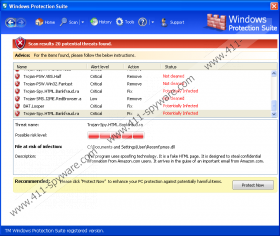
Windows Protection Suite screenshot Windows Protection Suite is fake security software, and a clone of the usual rogues: Extra Antivirus, Malware Destructor 2009, Windows Security Suite, Virus Doctor, Virus Melt, Virus Shield 2009, Virus Sweeper, etc.

Windows Protection Suite plays the usual scamware tricks: Windows Protection Suite sneaks onto your computer through a Trojan, or by websites that spoof scanning your system for threats. Once Windows Protection Suite is on your machine, it starts up when your system boots and launches a fake system scan. Windows Protection Suite scan results will tell you you’re infected with badware that it’s planted on your machine (a full list of fake files Windows Protection Suite creates is below). Don’t believe the scamware? Good for you, but Windows Protection Suite then drowns your computer with Windows Protection Suite popups and false system alerts. These fake warnings tell you an infection was found on your computer (”Warning! Your computer is infected!”) and that you’re sending data to a remote computer (”Unauthorized remote connection!”).

What’s the point? Windows Protection Suite wants to scare you into clicking its warnings, which’ll trick you into wasting money on the “full” — or “fool” — version of Windows Protection Suite. Even if you were actually infected with any of the nonsense Windows Protection Suite says you are, Windows Protection Suite can’t remove anything but dough from your wallet.

Before you set fire to your computer to stop those Windows Protection Suite popups, let me show you how to uninstall Windows Protection Suite.

Do You Have Windows Protection Suite?

When you’re infected with badware — whether it’s Windows Protection Suite, spyware, adware, a Trojan, or a virus — there are a few key symptoms. Have you noticed…

  • Slow computer performance: It just takes one parasite like Windows Protection Suite to slow your computer dramatically. If your PC takes longer than usual to reboot, or if your Internet connection is unusually slow, you may be infected with Windows Protection Suite.
  • New desktop shortcuts or switched homepage: Badware like Windows Protection Suite may change your Internet settings to redirect your homepage to another site. Badware can even add desktop shortcuts to your PC.
  • Annoying popups: Badware can bombard your computer with popup ads, even when you’re not online. Through these popups, you may be tricked into downloading more spyware.

How to Remove Windows Protection Suite Manually

Windows Protection Suite warning Before we get started, you should backup your system and your registry, so it’ll be easy to restore your computer if anything goes wrong.

To remove Windows Protection Suite manually, you need to delete Windows Protection Suite files. Not sure how to delete Windows Protection Suite files? Click here, and I’ll show you. Otherwise, go ahead and…

Block Windows Protection Suite websites:

http://windowsprotectionsuite.com/

Get rid of Windows Protection Suite files:

%Program Files%\WindowsProtectionSuite\WindowsProtectionSuite.exe
%Documents and Settings%\All Users\Application Data\345d567\WI345d.exe
%UserProfile%\Recent\std.exe
%UserProfile%\Recent\snl2w.exe
%UserProfile%\Recent\CLSV.exe
%UserProfile%\Desktop\WindowsProtectionSuite.exe
Windows Protection Suite.exe
uninstall.exe
WI345d.exe
CLSV.exe
grid.sys
%UserProfile%\Start Menu\Programs\Windows Protection Suite.lnk
%Documents and Settings%\All Users\Application Data\WINSSSys\winss.cfg
%Documents and Settings%\All Users\Application Data\345d567\WINSSSys\vd952342.bd
%Documents and Settings%\All Users\Application Data\345d567\working.log
%Documents and Settings%\All Users\Application Data\345d567\WINSS.ico
%Documents and Settings%\All Users\Application Data\345d567\WI345d.exe
%Documents and Settings%\All Users\Application Data\345d567\sqlite3.dll
%Documents and Settings%\All Users\Application Data\345d567\mozcrt19.dll
%Documents and Settings%\All Users\Application Data\345d567\26.mof
%Documents and Settings%\All Users\Application Data\WINSSSys
%Documents and Settings%\All Users\Application Data\345d567\WINSSSys
%Documents and Settings%\All Users\Application Data\345d567
%UserProfile%\Desktop\Windows Protection Suite 2009.lnk
%UserProfile%\Application Data\Microsoft\Internet Explorer\Quick Launch\Windows Protection Suite 2009.lnk
%UserProfile%\Application Data\Windows Protection Suite 2009\Instructions.ini
%UserProfile%\Application Data\Windows Protection Suite 2009
%UserProfile%\Start Menu\Programs\Windows Protection Suite 2009.lnk
%UserProfile%\Start Menu\Windows Protection Suite 2009.lnk
%UserProfile%\Desktop\WindowsProtectionSuite.exe
%UserProfile%\Start Menu\Programs\WindowsProtectionSuite\WindowsProtectionSuite Website.lnk
%UserProfile%\Start Menu\Programs\WindowsProtectionSuite\WindowsProtectionSuite.lnk
%UserProfile%\Start Menu\WindowsProtectionSuite.lnk
%UserProfile%\Start Menu\Programs\WindowsProtectionSuite
%Program Files%\Mozilla Firefox\searchplugins\search.xml
%Program Files%\WindowsProtectionSuite\WindowsProtectionSuite.url
%Program Files%\WindowsProtectionSuite\WindowsProtectionSuite.exe
%UserProfile%\Recent\std.exe
%UserProfile%\Recent\snl2w.exe
%UserProfile%\Recent\grid.sys
%UserProfile%\Recent\dudl.sys
%UserProfile%\Recent\DBOLE.drv
%UserProfile%\Recent\ANTIGEN.drv
%UserProfile%\Application Data\Windows Protection Suite\Instructions.ini
%UserProfile%\Application Data\Windows Protection Suite\cookies.sqlite
%UserProfile%\Application Data\Windows Protection Suite
%UserProfile%\Application Data\Microsoft\Internet Explorer\Quick Launch\Windows Protection Suite.lnk
%UserProfile%\Desktop\Windows Protection Suite.lnk
%UserProfile%\Application Data\Windows Protection Suite

Windows Protection Suite creates these fake files:

%UserProfile%\Recent\cb.sys
%UserProfile%\Recent\cid.dll
%UserProfile%\Recent\cid.tmp
%UserProfile%\Recent\CLSV.dll
%UserProfile%\Recent\CLSV.tmp
%UserProfile%\Recent\DBOLE.sys
%UserProfile%\Recent\ddv.dll
%UserProfile%\Recent\eb.sys
%UserProfile%\Recent\eb.tmp
%UserProfile%\Recent\energy.drv
%UserProfile%\Recent\energy.sys
%UserProfile%\Recent\exec.tmp
%UserProfile%\Recent\kernel32.drv
%UserProfile%\Recent\PE.drv
%UserProfile%\Recent\PE.tmp
%UserProfile%\Recent\ppal.exe
%UserProfile%\Recent\runddlkey.drv
%UserProfile%\Recent\snl2w.sys
%UserProfile%\Recent\tempdoc.dll

Delete Windows Protection Suite DLLs:

%Documents and Settings%\All Users\Application Data\345d567\sqlite3.dll
%Documents and Settings%\All Users\Application Data\345d567\mozcrt19.dll
%UserProfile%\Recent\SM.dll
%UserProfile%\Recent\tempdoc.dll
%UserProfile%\Recent\runddl.dll
%UserProfile%\Recent\PE.dll
%UserProfile%\Recent\grid.dll
%UserProfile%\Recent\energy.dll
%UserProfile%\Recent\kernel32.dll

Remove Windows Protection Suite registry keys:

HKEY_CURRENT_USER\Software\Microsoft\Windows\CurrentVersion\Run “WindowsProtectionSuite”
HKEY_CURRENT_USER\Software\Microsoft\Windows\CurrentVersion\Internet Settings\5.0\User Agent\Post Platform “9877034603″
HKEY_CLASSES_ROOT\CLSID\{3F2BBC05-40DF-11D2-9455-00104BC936FF}
HKEY_CLASSES_ROOT\WI345d.DocHostUIHandler
HKEY_CURRENT_USER\Software\Classes\Software\Microsoft\Internet Explorer\SearchScopes “URL” = “http://search-gala.com/?&uid=7&q={searchTerms}”

Note: In any Windows Protection Suite files I mention above, “%UserProfile%” is a variable referring to your current user’s profile folder. If you’re using Windows NT/2000/XP, by default this is “C:\Documents and Settings\[CURRENT USER]” (e.g., “C:\Documents and Settings\JoeSmith”). If you have any questions about manual Windows Protection Suite removal, go ahead and leave a comment.

How Do You Remove Windows Protection Suite Files?

Need help figuring out how to delete Windows Protection Suite files? While there’s some risk involved, and you should only manually remove Windows Protection Suite files if you’re comfortable editing your system, you’ll find it’s fairly easy to delete Windows Protection Suite files in Windows.

How to delete Windows Protection Suite files in Windows XP and Vista:

  1. Click your Windows Start menu, and then click “Search.”
  2. A speech bubble will pop up asking you, “What do you want to search for?” Click “All files and folders.”
  3. Type a Windows Protection Suite file in the search box, and select “Local Hard Drives.”
  4. Click “Search.” Once the file is found, delete it.

How to stop Windows Protection Suite processes:

  1. Click the Start menu, select Run.
  2. Type taskmgr.exe into the the Run command box, and click “OK.” You can also launch the Task Manager by pressing keys CTRL + Shift + ESC.
  3. Click Processes tab, and find Windows Protection Suite processes.
  4. Once you’ve found the Windows Protection Suite processes, right-click them and select “End Process” to kill Windows Protection Suite.

How to remove Windows Protection Suite registry keys:

Windows Protection Suite warning Because your registry is such a key piece of your Windows system, you should always backup your registry before you edit it. Editing your registry can be intimidating if you’re not a computer expert, and when you change or a delete a critical registry key or value, there’s a chance you may need to reinstall your entire system. Make sure your backup your registry before editing it.

  1. Select your Windows menu “Start,” and click “Run.” An “Open” field will appear. Type “regedit” and click “OK” to open up your Registry Editor.
  2. Registry Editor will open as a window with two panes. The left side Registry Editor’s window lets you select various registry keys, and the right side displays the registry values of the registry key you select.
  3. To find a registry key, such as any Windows Protection Suite registry keys, select “Edit,” then select “Find,” and in the search bar type any of Windows Protection Suite’s registry keys.
  4. As soon as Windows Protection Suite registry key appears, you can delete the Windows Protection Suite registry key by right-clicking it and selecting “Modify,” then clicking “Delete.”

How to delete Windows Protection Suite DLL files:

  1. First locate Windows Protection Suite DLL files you want to delete. Open your Windows Start menu, then click “Run.” Type “cmd” in Run, and click “OK.”
  2. To change your current directory, type “cd” in the command box, press your “Space” key, and enter the full directory where the Windows Protection Suite DLL file is located. If you’re not sure if the Windows Protection Suite DLL file is located in a particular directory, enter “dir” in the command box to display a directory’s contents. To go one directory back, enter “cd ..” in the command box and press “Enter.”
  3. When you’ve located the Windows Protection Suite DLL file you want to remove, type “regsvr32 /u SampleDLLName.dll” (e.g., “regsvr32 /u jl27script.dll”) and press your “Enter” key.

That’s it. If you want to restore any Windows Protection Suite DLL file you removed, type “regsvr32 DLLJustDeleted.dll” (e.g., “regsvr32 jl27script.dll”) into your command box, and press your “Enter” key.

Did Windows Protection Suite change your homepage?

  1. Click Windows Start menu > Control Panel > Internet Options.
  2. Under Home Page, select the General > Use Default.
  3. Type in the URL you want as your home page (e.g., “http://www.homepage.com”).
  4. Select Apply > OK.
  5. You’ll want to open a fresh web page and make sure that your new default home page pops up.

Windows Protection Suite Removal Tip

Is your computer acting funny after deleting any Windows Protection Suite files? I recommend using a program like File Recover from PC Tools. File Recover saves deleted files that otherwise can’t be recovered by Windows operating sytem.

Want to save time finding Windows Protection Suite files? Download Spyware Doctor, let it find the Windows Protection Suite files for you, and then manually delete Windows Protection Suite files.

How Did You Get Windows Protection Suite?

Wondering how Windows Protection Suite ended up on your PC? If you’re infected with Windows Protection Suite or other badware, perhaps you were using…

  • Freeware or shareware: Did you download and install shareware or freeware? These low-cost or free software applications may come bundled with spyware, adware, or programs like Windows Protection Suite. Sometimes adware is attached to the free software to “pay” developers for the cost of creating the software, and more often spyware is secretly attached to free software to harm your computer and steal your personal and financial information.
  • Peer-to-peer software: Do you use a peer-to-peer (P2P) program or other application with a shared network? When you use these applications, you put your system at risk for unknowingly downloading an infected file, including applications like Windows Protection Suite.
  • Questionable websites: Did you visit a website that’s of questionable nature? When you visit malicious sites that are fishy and phishy, badware may be automatically downloaded and installed onto your computer, sometimes including applications like Windows Protection Suite. I recommend you use Firefox web browser, if you don’t already.

Understanding Windows Protection Suite

If you’re infected with Windows Protection Suite, you should know what you’re fighting. I’ll explain some definitions related to Windows Protection Suite.

Windows Protection Suite May Be Rogue Anti-Spyware

Rogue anti-spyware refers to anti-spyware/antivirus software of questionable value. Rogue anti-spyware may not be proven to protect your computer from spyware, may popup fake alerts or create many false positives about your PC being infected, or may use scare tactics to try to get you to purchase the application. Rogue anti-spyware software may be installed by a Trojan, come bundled with other software, or install itself through web browser security holes. While it is fairly rare, some rogue anti-spyware is created and distributed by known spyware or adware companies, and the rogue anti-spyware may install spyware or adware itself.

Often when you’re infected with rogue anti-spyware like Windows Protection Suite, you’ll see a false popup security alert like this:

Windows Protection Suite  popup

Rogue Anti-Spyware Tactics

Typically, rogue anti-spyware such as Windows Protection Suite has one or more of the qualities listed below, which is why rogue anti-spyware is considered anti-spyware software of questionable value.

  • False positives/fake alerts: Rogue anti-spyware may produce a large number of false positives or use fake alerts, noting that your computer is infected with spyware parasites or other threats that do not really exist.
  • Copycat looks: Rogue anti-spyware may copy the look and feel of other legitimate or rogue anti-spyware applications. Often, rogue anti-spyware applications may appear as close clones of other rogue anti-spyware software.
  • High pressure marketing: Rogue anti-spyware may use scare tactics or other aggressive advertising and marketing tactics to try to trick you into buying the rogue anti-spyware application. Often, rogue anti-spyware may produce false positives and fake alerts about your computer being infected.
  • Poor detection/scan reporting: Rogue anti-spyware may produce poor reports when it scans your PC. For example, rogue anti-spyware may say your computer is infected 11 parasites, but not specify which spyware parasites or what type of parasites. Rogue anti-spyware may also report that your PC is infected with SafeAndClean, but not tell you which related files, DLLS, etc. were found on your computer.
  • Weak scanning/detection: Rogue anti-spyware may not only poorly report on computer infection, but rogue antispyware may also poorly scan your PC. Rogue anti-spyware may skip over important folders and files of your computer that should be scanned to detect spyware.

Did Windows Protection Suite use these tactics to trick you into buying Windows Protection Suite?