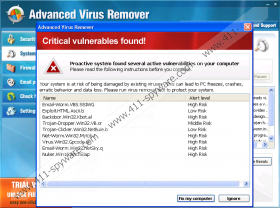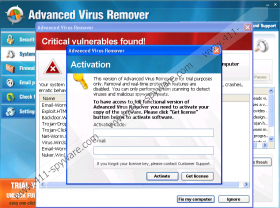
Advanced Virus Remover — AKA AdvancedVirusRemover — is scareware software that’s posing as an antivirus application. Like other scareware, Advanced Virus Remover will spoof system alerts about imaginary threats, to trick you into wasting dough on Advanced Virus Remover. One of these Advanced Virus Remover popups read:
“System warning! Continue working in unprotected mode is very dangerous. Viruses can damage your confidential data and work on your computer. Click here to protect your computer.”
System warning: you’re likely only infected with scam software.
Before Advanced Virus Remover pop-up alerts make you take baseball to your PC, let me show you how to uninstall Advanced Virus Remover.
GET RID of Advanced Virus Remover
- Manually remove Advanced Virus Remover with step-by-step instructions
- Download Spyware Doctor to automatically remove Advanced Virus Remover
- You can download award-winning, anti-badware software SpywareDoctor to easily remove Advanced Virus Remover. Want to know why I dig SpywareDoctor? Read my review.
Do You Have Advanced Virus Remover?
When you’re infected with badware — whether it’s Advanced Virus Remover, spyware, adware, a Trojan, or a virus — there are a few key symptoms. Have you noticed…
- Slow computer performance: It just takes one parasite like Advanced Virus Remover to slow your computer dramatically. If your PC takes longer than usual to reboot, or if your Internet connection is unusually slow, you may be infected with Advanced Virus Remover.
- New desktop shortcuts or switched homepage: Badware like Advanced Virus Remover may change your Internet settings to redirect your homepage to another site. Badware can even add desktop shortcuts to your PC.
- Annoying popups: Badware can bombard your computer with popup ads, even when you’re not online. Through these popups, you may be tricked into downloading more spyware.
How to Remove Advanced Virus Remover Manually
Before we get started, you should backup your system and your registry, so it’ll be easy to restore your computer if anything goes wrong.
To remove Advanced Virus Remover manually, you need to delete Advanced Virus Remover files. Not sure how to delete Advanced Virus Remover files? Click here, and I’ll show you. Otherwise, go ahead and…
Get rid of Advanced Virus Remover files:
c:\Program Files\AdvancedVirusRemover
%UserProfile%\Application Data\Microsoft\Internet Explorer\Quick Launch\Advanced Virus Remover.lnk
%UserProfile%\Desktop\Advanced Virus Remover.lnk
%UserProfile%\Start Menu\Advanced Virus Remover.lnk
Delete Advanced Virus Remover registry entries:
HKEY_CURRENT_USER\Software\AVR
Note: In any Advanced Virus Remover files I mention above, “%UserProfile%” is a variable referring to your current user’s profile folder. If you’re using Windows NT/2000/XP, by default this is “C:\Documents and Settings\[CURRENT USER]” (e.g., “C:\Documents and Settings\JoeSmith”). If you have any questions about manual Advanced Virus Remover removal, go ahead and leave a comment.
How Do You Remove Advanced Virus Remover Files?
Need help figuring out how to delete Advanced Virus Remover files? While there’s some risk involved, and you should only manually remove Advanced Virus Remover files if you’re comfortable editing your system, you’ll find it’s fairly easy to delete Advanced Virus Remover files in Windows.
How to delete Advanced Virus Remover files in Windows XP and Vista:
- Click your Windows Start menu, and then click “Search.”
- A speech bubble will pop up asking you, “What do you want to search for?” Click “All files and folders.”
- Type a Advanced Virus Remover file in the search box, and select “Local Hard Drives.”
- Click “Search.” Once the file is found, delete it.
How to stop Advanced Virus Remover processes:
- Click the Start menu, select Run.
- Type taskmgr.exe into the the Run command box, and click “OK.” You can also launch the Task Manager by pressing keys CTRL + Shift + ESC.
- Click Processes tab, and find Advanced Virus Remover processes.
- Once you’ve found the Advanced Virus Remover processes, right-click them and select “End Process” to kill Advanced Virus Remover.
How to remove Advanced Virus Remover registry keys:
Because your registry is such a key piece of your Windows system, you should always backup your registry before you edit it. Editing your registry can be intimidating if you’re not a computer expert, and when you change or a delete a critical registry key or value, there’s a chance you may need to reinstall your entire system. Make sure your backup your registry before editing it.
- Select your Windows menu “Start,” and click “Run.” An “Open” field will appear. Type “regedit” and click “OK” to open up your Registry Editor.
- Registry Editor will open as a window with two panes. The left side Registry Editor’s window lets you select various registry keys, and the right side displays the registry values of the registry key you select.
- To find a registry key, such as any Advanced Virus Remover registry keys, select “Edit,” then select “Find,” and in the search bar type any of Advanced Virus Remover’s registry keys.
- As soon as Advanced Virus Remover registry key appears, you can delete the Advanced Virus Remover registry key by right-clicking it and selecting “Modify,” then clicking “Delete.”
How to delete Advanced Virus Remover DLL files:
- First locate Advanced Virus Remover DLL files you want to delete. Open your Windows Start menu, then click “Run.” Type “cmd” in Run, and click “OK.”
- To change your current directory, type “cd” in the command box, press your “Space” key, and enter the full directory where the Advanced Virus Remover DLL file is located. If you’re not sure if the Advanced Virus Remover DLL file is located in a particular directory, enter “dir” in the command box to display a directory’s contents. To go one directory back, enter “cd ..” in the command box and press “Enter.”
- When you’ve located the Advanced Virus Remover DLL file you want to remove, type “regsvr32 /u SampleDLLName.dll” (e.g., “regsvr32 /u jl27script.dll”) and press your “Enter” key.
That’s it. If you want to restore any Advanced Virus Remover DLL file you removed, type “regsvr32 DLLJustDeleted.dll” (e.g., “regsvr32 jl27script.dll”) into your command box, and press your “Enter” key.
Did Advanced Virus Remover change your homepage?
- Click Windows Start menu > Control Panel > Internet Options.
- Under Home Page, select the General > Use Default.
- Type in the URL you want as your home page (e.g., “http://www.homepage.com”).
- Select Apply > OK.
- You’ll want to open a fresh web page and make sure that your new default home page pops up.
Advanced Virus Remover Removal Tip
Is your computer acting funny after deleting any Advanced Virus Remover files? I recommend using a program like File Recover from PC Tools. File Recover saves deleted files that otherwise can’t be recovered by Windows operating sytem.
Want to save time finding Advanced Virus Remover files? Download Spyware Doctor, let it find the Advanced Virus Remover files for you, and then manually delete Advanced Virus Remover files.
How Did You Get Advanced Virus Remover?
Wondering how Advanced Virus Remover ended up on your PC? If you’re infected with Advanced Virus Remover or other badware, perhaps you were using…
- Freeware or shareware: Did you download and install shareware or freeware? These low-cost or free software applications may come bundled with spyware, adware, or programs like Advanced Virus Remover. Sometimes adware is attached to the free software to “pay” developers for the cost of creating the software, and more often spyware is secretly attached to free software to harm your computer and steal your personal and financial information.
- Peer-to-peer software: Do you use a peer-to-peer (P2P) program or other application with a shared network? When you use these applications, you put your system at risk for unknowingly downloading an infected file, including applications like Advanced Virus Remover.
- Questionable websites: Did you visit a website that’s of questionable nature? When you visit malicious sites that are fishy and phishy, badware may be automatically downloaded and installed onto your computer, sometimes including applications like Advanced Virus Remover. I recommend you use Firefox web browser, if you don’t already.
Understanding Advanced Virus Remover
If you’re infected with Advanced Virus Remover, you should know what you’re fighting. I’ll explain some definitions related to Advanced Virus Remover.
Advanced Virus Remover May Be Rogue Anti-Spyware
Rogue anti-spyware refers to anti-spyware/antivirus software of questionable value. Rogue anti-spyware may not be proven to protect your computer from spyware, may popup fake alerts or create many false positives about your PC being infected, or may use scare tactics to try to get you to purchase the application. Rogue anti-spyware software may be installed by a Trojan, come bundled with other software, or install itself through web browser security holes. While it is fairly rare, some rogue anti-spyware is created and distributed by known spyware or adware companies, and the rogue anti-spyware may install spyware or adware itself.
Often when you’re infected with rogue anti-spyware like Advanced Virus Remover, you’ll see a false popup security alert like this:

Rogue Anti-Spyware Tactics
Typically, rogue anti-spyware such as Advanced Virus Remover has one or more of the qualities listed below, which is why rogue anti-spyware is considered anti-spyware software of questionable value.
- False positives/fake alerts: Rogue anti-spyware may produce a large number of false positives or use fake alerts, noting that your computer is infected with spyware parasites or other threats that do not really exist.
- Copycat looks: Rogue anti-spyware may copy the look and feel of other legitimate or rogue anti-spyware applications. Often, rogue anti-spyware applications may appear as close clones of other rogue anti-spyware software.
- High pressure marketing: Rogue anti-spyware may use scare tactics or other aggressive advertising and marketing tactics to try to trick you into buying the rogue anti-spyware application. Often, rogue anti-spyware may produce false positives and fake alerts about your computer being infected.
- Poor detection/scan reporting: Rogue anti-spyware may produce poor reports when it scans your PC. For example, rogue anti-spyware may say your computer is infected 11 parasites, but not specify which spyware parasites or what type of parasites. Rogue anti-spyware may also report that your PC is infected with SafeAndClean, but not tell you which related files, DLLS, etc. were found on your computer.
- Weak scanning/detection: Rogue anti-spyware may not only poorly report on computer infection, but rogue antispyware may also poorly scan your PC. Rogue anti-spyware may skip over important folders and files of your computer that should be scanned to detect spyware.
Did Advanced Virus Remover use these tactics to trick you into buying Advanced Virus Remover?

Traduzca al Español
Übersetzen Sie zum Deutsch
Traduisez au Français
Traduca ad Italiano
Vertaal aan het Nederlands
Μεταφράστε στα ελληνικά
Översätta till Svensk
ترجمة الى العربية
中文翻译
한국어에게 번역하십시오
日本語に翻訳しなさい
Traduza ao Português
Переведите к русскому
Just restore your computer with the Restore Disc’s that came with your computer. There is no one that actually knows how to remove this VIRUS! Just a whole lot of talk and false promises, I have tried a lot of the suggestions on the Web to no avail and was left with the option of a complete restore.
Most of my attempts to implement the suggestions on this web page or the comments section failed. Finally I had to analyze the processes with ProcMon. Turns out that the culprit is “winupdate86.exe”. I had to download a separate task manager-style program (a freeware called Process Killer) to kill winupdate86.exe. Then I went into the system startup with start–>run–>”msconfig” and removed winupdate86 from the startup. Then once you restart you can access the registry, delete the necessary registry keys and re-enable the task manager. This page shows the key you need to go to:
http://www.theeldergeek.com/en.....anager.htm
thanks,
the information helped me to get rid of Advanced Virus Remover…… :)
Advanced Virus Remover will not let me into
the task amanger or let me run regedit any ideaas?
I’ve fixed this a couple of times now. My dad and his friends have been passing it around a lot lately. The quickest and easiest removal method I’ve found is to…
First disconnect from the internet and do not acknowledge any of the AVR GUIs. Just push them to the side. Use window explorer to peruse the program files directory. You should find a directory named Advance Virus Remover(al). Note the creation date. The trick is to roll back to a restore point before this date. The assumption here is that you haven’t been able to do anything meaningful since that date anyway so no loss.
To get to the restore point GUI, attempt something that generates the “this file is infected, can’t run…” GUI. For example, cntl-alt-del in a futile attempt at starting the task manager. Don’t cancel or acknowledge the AVR form. Leave it on the screen. (This is very important!) Next, start -> all programs -> accessories -> command prompt. From the command line, cd to c:\windows\system32\restore and fire up system restore (rstrui.exe). This should start the restore GUI. Pick a restore point before the AVR creation date. When the system reboots, you should be good to go. Highly recommended to then run a full virus scan first thing. AVR is nasty nasty.
If you’re having issues running .exe’s (AVR generates a nasty popup then cancel’s the command), I found that if you leave the popup displayed, subsequent .exe’s succeed. A window gui blocking thing? Don’t know. But with this little trick, you can then get to things like the task manager or command tool. After that, it’s pretty straight forward to start killing processes, deleting files and cleaning up your registry.
My home PC is infected with Advanced Virus Remover. I tried to recover with Fix-It Utilities. Now Windows XP will not complete start-up ; I only get my wallpaper. Is there any way to recover from this so I can get to the data on my harddrive ?
AVR seems to have been removed from my computer. I deleted the program files and registry entries manually in safe mode because AVR was blocking my web browsers and .exe programs. The popups aren’t there anymore and I can access the Internet and run other programs now. Thanks for the article, it seems to have saved my laptop.
I downloaded a free copy of Malwarebytes to help me get rid of this. After I scanned my computer with that program I was able to go back and follow the manual removal instructions. I do not see any more signs of it being on my computer but I think I am going to continue to scan just to be sure. I hope this helps.
whenever I try to run task manager, a warning note pops up saying adminastrative privliges are disabled or something like that, can you please help me,
thankyou
my disk defragmenter does not work. It runs for 3 seconds and then tells me it is finished.
I followed the directions above to get access to the task mgr and then deleted all the files and the registry entries as noted. However, when I reboot the computer, the AVR seems to come back. Any suggestions?
Hi
I have been having difficulties with the advances virus remover all day. It keeps popping saying i nedd to remove the some threats i haven no clue in what to do. Please Help
I tried Spy Bot Search and Destroy and for about ONE HOUR the alert from “Advanced Virus Remover” was stopped. But it came back. I am running now, and again Spybot.
Apareceu-me o alerta insistente do “Advanced Virus Remover” pela primeira vez hoje 01SET09. Não conseguia abrir o Winrar, nem abrir ficheiros de video.
Os avisos eram constantes. Procurei na net e vim dar a este site.
Entretanto lembrei-me de actualizar e “correr” o Spybot Search and Destroy, a apareceram alguns avisos de mal-ware e deixei o Spy Bot eliminar tudo. Entretanto os alertas do tal “Advanced Virus Remover” TERMINARAM, logo de seguida. Veremos se foi de vez ou não….
I am had the same problems described above – could not access taskmgr nor system restore. I have McAfee Security Suite and it did not find and fix the problem. I used Malwarebytes Anti-Malware to find and remove the files. However I still cannot access the internet from that PC and some other things are still not right.
i had to run mal-ware bytes- its a free program. then i was able to acess my control panel and ctrl alt del. then i ended the pavm file then i could delete it from program files
I’m having the same problem as a lot of people here seem to. I’m trying to get rid of AVR but I can’t open taskmgr or regedit because “the file is infected.” I can’t delete PAVRM.exe because the file is in use. I’d really like to get rid of this as soon as possible, does anyone know how to fix this?
I cannot pul up taskmgr or regedit because they are infected plus when I find PAVRM it will not let me delete because it reports being used by another program, I still have the black screen in the middle warning infection help?
Barrett,
Any luck with the AVR scareware? I’m having the same issues with not being able to access either the registry or the task manager.
-Eric
Hi, Jenny. I found this on Antivirus.About.com’s article, “How to Enable Task Manager.”
1. Click Start
2. Click Run
3. Type REGEDIT
4. Click OK The Registry Editor will now open
5. Browse to the following key:
HKEY_CURRENT_USER\Software\Microsoft\Windows\
CurrentVersion\Policies\system
6. In the right pane, look for the value: DisableTaskMgr
7. Right click DisableTaskMgr and select Delete. (When prompted with “Are you sure you want to delete this value”, select Yes.
8. Now browse to the following key:
HKEY_LOCAL_MACHINE\SOFTWARE\Microsoft\Windows\
CurrentVersion\policies\system
9. In the right pane, look for the value: DisableTaskMgr
10. Right click DisableTaskMgr and select Delete. (When prompted with “Are you sure you want to delete this value”, select Yes.
11. Close the Registry by choosing File | Exit
12. You should now be able to access Task Manager. If not, reboot into Safe Mode and repeat the steps outlined above.
My computer won’t restart. It freezes at the welcome screen. Advanced Virus Remover crashed it and now it won’t restart. It did this in about half an hour. When it started popping up I ran scans with what we had (Norton and SpySweeper) and ignored AVR’s popups. It’s a Window’s XP desktop. Help please!
I can’t find how to restore the task manager. can you help me? thanks!
Where is that page that says how to restore the task manager? I can’t find it on the search.
look at the page to restore your task manager. it’s very helpful.
I am unable to locate the registry keys by searching on AVR and CpMRU and I did not have a subfile after Internet Explorer labeled International
yea the same thing happens to me. how do i get around it?
I’m trying to manually remove this AVR scareware, but when I try to access either the task manager or the registry, I get a warning that I assume is from the program saying the file is infected and cannot be opened. Also, when I try to delete the program itself, I get an error saying the program is in use and cannot be deleted. That message also looks like the other messages from the program. Is there another way around this? Thank you.