
CasaleMedia
CasaleMedia is a tracking cookie that monitors your Internet browsing habits in order to track when you see online advertisements. According to the official website for CasaleMedia, the cookies are used for two main purposes. Firstly, CasaleMedia tracking cookie checks whether you have seen a particular advertisement served by the company already.
Top Threats
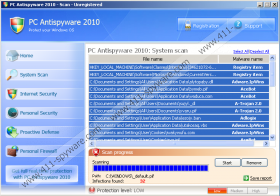
PC Antispyware 2010
The infamous Home Antivirus 2010 now has a clone called PC Antispyware 2010. It is a rogue computer security program that will slow down your computer and will try to steal your money by urging you to pay for registration. The reason why PC Antispyware 2010 is so eager to sell you this worthless product is that it has been created by cyber criminals who want to get easy money as soon as possible.
BTCWare-PayDay Ransomware
If BTCWare-PayDay Ransomware finds a way to enter your system, you may be left with encrypted files that you will never be able to use again. The ransomware infection can be a real nightmare as there is no free tool yet...Trojan FakeAlert
Trojan FakeAlert is a fake alert which is used in the attacks against PCs by various rogue antispyware applications. It is not a genuine threat in itelf, but instead a fabricated lie made up by developers of rogueware...AntiMalware
AntiMalware is a rogue antispyware application that looks and behaves a lot like a real antivirus program. It should be obvious from its name that it tries to be come across as a legitimate product, but there should be...OnlineSportsSearch
If you are planning on installing OnlineSportsSearch, we suggest that you change your course of action. Although this extension might seem useful, it is not, and you will come to regret letting it in sooner or later. So why bother with this potentially unwanted program (PUP) at all? Have you downloaded it already? If that is the case, and you know that you want to delete OnlineSportsSearch, we share tips that we are sure will help you eliminate this PUP quickly. If you are not sure if you want to remove this extension, and if you are not sure why it is identified as a threat at all, you want to keep reading too because we share all the information you need to know about this strange PUP. ...
NetGameSearch
If you’re looking for ways to get new video games, may we suggest using official vendor or distributor sites instead of going somewhere shady? There’s a good chance that trying to avoid paying for the product you might get exposed to something like NetGameSearch. Now this application is a browser extension, and it clearly isn’t a malicious infection, but it could still hinder your browsing experience by constantly redirecting you to third-party websites. If you happen to have this extension on-board, please consider removing NetGameSearch today. For manual removal, you can find the guidelines at the bottom of this page. ...
Omfl Ransomware
If you’ve recently received an email from an unknown party, and you’ve opened the file attached to it, and then suddenly all your files are locked, congratulations, you’ve been infected with ransomware. It’s probably the Omfl Ransomware infection, too. It is one of the latest additions to the ever-growing STOP Ransomware family, and you can remove this program just like all the others that came before it. There is also a way to restore at least some of your files, but please be aware that some of your data might be lost for good. ...
GetSearchConverter
Are you looking for a tool that would make your searches more efficient? GetSearchConverter might sound like a tool that offers just that, but our researchers warn that it is not. Instead, it is just another PUP (potentially unwanted program) that was created for Google Chrome users to access their browsing data and to expose them to sponsored content that belongs to unknown third parties. Are you interested in such services? We are sure that you are not, and perhaps that is why you are reading this report. If you continue reading, you will learn not only how to delete GetSearchConverter but also GameSearchMedia, TopSportsSearch, IncognitoSearchPro, and other identical PUPs. ...
GameSearchMedia
Are you tired of the online games you play every day? If you are, GameSearchMedia might seem to offer a solution. After all, isn’t it a tool that should help you search for new games? Well, you should not pay attention to the names of extensions in all cases. That is because they can be misleading. In fact, this particular extension has nothing to do with gaming at all. It hijacks the default search provider, but only to redirect users’ searches to search.yahoo.com. Where is the problem with that? We explain that further in our report, but note that you should never trust suspicious extensions that redirect searches to popular search engines and claim to present optimized or enhanced search results. ...
Qlkm Ransomware
One minute you are working on your computer, and the next, you discover that Qlkm Ransomware has slithered in and corrupted your files. This is how fast this malware works. Once it is done, you will see that your personal files have blank file icons, that they have the additional ‘.qlkm’ extension, and that you cannot read them. Is there a program that can read them? There is a tool named ‘STOP Decryptor’ that should decrypt at least some of the files for free, but we cannot promise that it will work for you. Unfortunately, decryptors for ransomware rarely exist, and their victims usually end up losing all personal files. ...
Quick Recipes
Do not install Quick Recipes without fully understanding how this extension works. The same can and should be applied to everything that you install, but especially unfamiliar extensions and programs. If you think that you already know enough about this particular extension because you read the information presented via chrome.google.com/webstore/detail/quick-recipes/ankdghfaanppinilbedkbcipgmdpgcmn or quickrecipessearch.com, let us remind you that official information is always meant to reassure users. What you must do instead is look at the reviews of authentic users and also trusted cybersecurity researchers. ...
Newmode.biz
Getting flooded with Newmode.biz pop-ups is very annoying, but it’s not the end of the world. Also, it doesn’t mean that you got infected with malware or anything like that. Your browser’s settings were modified when you encountered some adware component online. To revert the modifications, you need to restore your browser’s settings to default. You can follow the instructions at the bottom of this description, or you can employ a powerful security tool that will help you terminate all the potential threats automatically. Whichever you choose to do, don’t forget that it’s for the sake of your cybersecurity. ...
Vvoa Ransomware
Vvoa Ransomware shows no mercy once it invades a vulnerable Windows system, as it immediately encrypts all personal files. Whether it is a work document, a project for school, or an important photo from your childhood, this malware encrypts it, and that ensures that you cannot read it anymore. The goal is not to destroy your files but to make you pay for a decryptor that, allegedly, would restore the files. Unfortunately, cybercriminals are schemers, and they are likely to promise a decryptor just so that you would give up your savings. That is how Vpsh Ransomware, Agho Ransomware, Sglh Ransomware, and many other infections from the STOP Ransomware family operate as well. ...
Agho Ransomware
Agho Ransomware is one of the thousands of infections that have been created to corrupt documents, videos, presentations, projects, notes, photos, and other personal files. These infections corrupt these kinds of files because they intend to hit victims where it hurts most. If system files were corrupted, they could be replaced, and the system could be reinstalled. However, when personal files are encrypted, victims might panic and fall into despair. That is a recipe for disaster because cybercriminals know that it is easier to scam people who are more vulnerable. ...